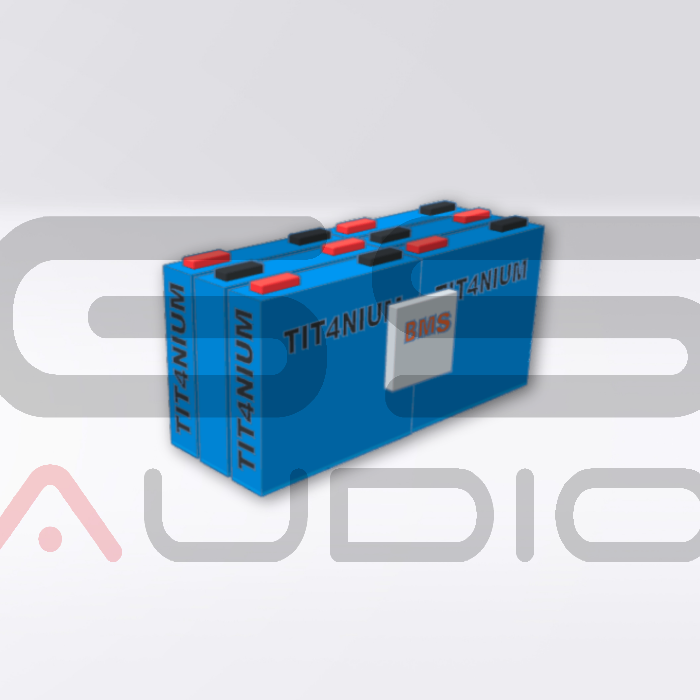
LTO TITANIUM 14.4V 20Ah Battery Pack - 6 Cells with BMS and Bars - 23x6.5x11cm
Ready to use: 14.4V 20Ah LTO Titanium Tit4nium® battery pack, consisting of 6 prismatic 20Ah cells, with integrated BMS, aluminum bus bar, loaded and balanced.
Designed for high-power car audio systems, it is indicatively suitable for systems up to 1800-2400 WRMS.
Actual performance depends on technical factors such as alternator charging voltage, distance between batteries and amplifiers, and quality of wiring.
WEIGHT: about 3.5 kg.
DIMENSIONS: 23 x 6.5 x H 11cm
Cell quality and control
GS Audio cells of GRADE A, selected and ultra-low internal resistance, with guaranteed values.
Inrush and internal resistance tests are documented in the quality control sheet included inside the battery pack.
Charging and alternator compatibility
The recommended charging voltage is between 14.4V and 15V. If the alternator operates at a voltage below 14.4V, we recommend:
the installation of an upgraded alternator
The use of 2.3V cylindrical LTO cells, which are more suitable for systems with lower charging voltages
Shipping and assembly
LTO Titanium battery packs are assembled to order and take up to 2 business days before shipping.
Lightweight batteries are packed reinforced with wood and Styrofoam, while batteries ≥25 kg are shipped on pallets in custom-made wooden crates. Preparation may take 1 additional day.
SHIPPING THROUGHOUT EUROPE
Customized configurations
Upon request we make custom kits of 6, 12, 18, 24, 30, 60, 120 or more cells, assembled according to the desired scheme, complete with BMS and bus bar, ready for in-car installation.
CAUTION: there is only one worldwide manufacturer of prismatic LTO cells of this type: Toshiba, which makes only 20Ah cells.
Be wary of those who claim higher capacities: they do not correspond to original LTO cells.
SINGLE CELL RATINGS
Model GS - 20 LTO | Dimensions 108x22x116 mm | Weight / Volume 0.520 KG / 0.26 L |
Nominal Voltage 2.4 Volts | Nominal single cell charging current 20A 40 A | Rated single cell discharge current 20A 40 A |
Maximum single cell charge current 20A 100 A | 20A maximum single cell discharge current 20C = 400A | Connection threads M5 |
20A single cell internal resistance <0.5 mOhm | Optimum working temperature -25 / + 55°C | Maximum working temperature -30 / + 70 °C |
Charging method constant current and voltage | Maximum voltage 2.7V x 6 = 16.2V | Minimum voltage 1.7V x 6 = 10.2V |
Certified safety: The battery pack passes the tests required by GB/T 31485, which verify the behavior in case of
-
short circuit, overcharge, heating, puncture, compression and immersion in salt water
deep discharge, low temperature, low atmospheric pressure and thermal shock
No fire, explosion or leakage occurs under all conditions tested.
Want to know more?
LTO CHARACTERISTICS
Structure and characteristics of lithium titanate (LTO) batteries
Lithium titanate (LTO) batteries differ from classical lithium-ion batteries in the composition of the anode. In these cells, lithium titanate oxide (Li₂TiO₃) replaces graphite (carbon), typically used in conventional batteries. The cathode can be lithium manganese oxide (LMO) or lithium manganese cobalt oxide (NMC).
At the microscopic level, the LTO has a three-dimensional structure composed of lithium titanate nanocrystals. This configuration enables an operating voltage of 2.4 V, fast charging, and the ability to withstand discharge currents up to 10 times the rated capacity.
Benefits of LTO technology
One of the main strengths of lithium titanate batteries is the greater surface area available for electron passage. The anode has a surface area of about 100 m² per gram, compared with only 3 m² per gram in conventional 3.7 V lithium-ion batteries. This feature enables extremely fast recharging and a significantly longer service life. LTO batteries can be recharged in 6-10 minutes, compared with 8 hours required for standard rechargeable batteries, with a charging efficiency of more than 98%.
Safety and thermal stability
The lower operating voltage of 2.4 V offers significant advantages in terms of safety and environmental impact. The absence of carbon in LTO cells reduces the risk of thermal instability and overheating, eliminating a major cause of fires in conventional storage systems.
Independent tests conducted on LTO batteries show that, even in the event of a short circuit, the maximum temperature reached does not exceed 90-100 °C, without causing explosions or fires. This makes LTO batteries a much safer solution than LiPo (lithium-polymer) batteries.







Validate your login